
This is educational content, not a substitute for therapy.
Understanding Protest Behaviors in Relationships: What Your Panic Is Actually Trying to Tell You
You swore you wouldn’t send that text.
You stared at the timestamp on your screen—one hour, two hours, three hours since their last message—feeling that familiar, nauseating knot tighten in the center of your chest. Your rational mind knew they were probably stuck in traffic, wrapped up in a work meeting, or simply having dinner with a friend.
Yet, within forty-five minutes, your fingers moved on autopilot. You typed out a biting, passive-aggressive one-liner: “Must be nice to be so busy you can’t even send a two-second text. Have a great night.” Or perhaps you took the opposite route: you abruptly silenced your notifications, crossed your arms in cold silence, and resolved that when they finally do call, you will reject it to make them sweat.
Five minutes later, the adrenaline drops, leaving a heavy wash of shame in its place: Why did I do that? Why do I always turn into this desperate, hyper-reactive version of myself the moment someone pulls away?
Here is the truth: you are not crazy, you are not inherently broken, and you are not an emotionally volatile villain. You are experiencing protest behaviors in relationships.
Let’s unpack the exact psychological wiring behind why you do this, challenge the unhelpful relationship advice keeping you trapped in this loop, and explore how to transition into earned security.
What Are Protest Behaviors? The Clinical Definition
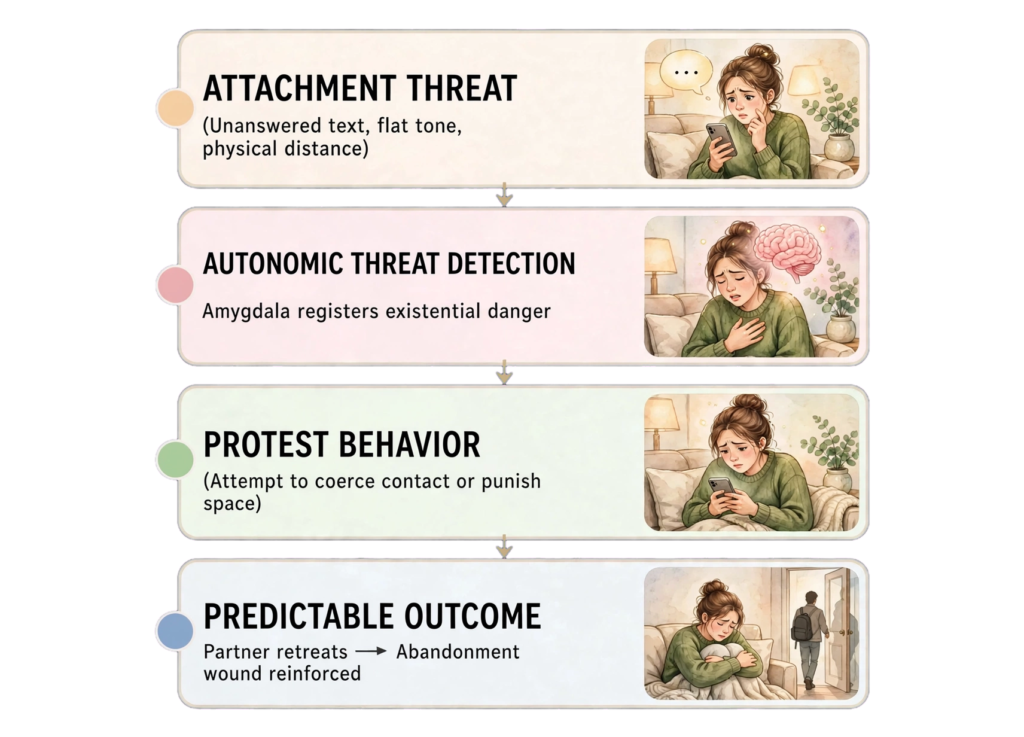
The concept of protest behavior does not come from pop-psychology buzzwords or trending dating tips. It has concrete roots in developmental psychology.
In the mid-20th century, British psychoanalyst John Bowlby’s attachment theory documented how infants react when physically separated from their primary caregiver. Bowlby observed an instinctive, evolutionary sequence: the moment proximity was threatened, infants entered an active state of protest—crying, screaming, thrashing, and clinging to compel the caregiver to return. In nature, physical distance from a protector meant death.
Decades later, researchers Dr. Amir Levine and Rachel Heller, authors of Attached: The New Science of Adult Attachment, established that adult romantic relationships rely on the exact same neurological hardware.
In adulthood, a protest behavior is any indirect, manipulative, or hostile action you take to force emotional proximity, demand reassurance, or preemptively punish your partner when you perceive a threat to your connection.
When your attachment system feels insecure, you don’t express your fear cleanly. Instead, you launch an emotional flare designed to provoke a reaction. Recognizing this pattern is fundamental to uncovering the deeper core wounds in relationships that drive our adult reactivity.
The 6 Classic Faces of Protest Behaviors in Daily Life
Protest behaviors rarely present as a calm request for comfort. Instead, they disguise themselves in behaviors that sabotage the very safety you are seeking:
1. Compulsive Pursuit and Digital Stalking
You call four times in a row. You send paragraphs dissecting why their tone changed over breakfast. You obsessively inspect their social media activity, cross-referencing their “Active 10m ago” status on Instagram with their unread WhatsApp message. Your nervous system demands immediate sensory evidence that the bond still exists.
2. The Weaponized Cold Shoulder (Punitive Stonewalling)
You give one-word answers. You walk into the apartment, deliberately avoid eye contact, and clean the kitchen with aggressive clatter. When they ask, “Is everything okay?” you sneer, “I’m fine.” You are holding your presence hostage, hoping they will read your mind, notice your distress, and chase after you to prove your worth.
3. Relational Scorekeeping
“They took two hours and twelve minutes to reply to my message, so I am setting an alarm to wait two hours and thirty minutes before responding to theirs.” You turn communication into a game of emotional accounting to avoid feeling like the one who cares more.
4. Manufacturing False Independence
You declare: “Whatever. Do what you want. I don’t need anything from you anyway.” You pull your heart back behind an iron wall of hyper-independence. The subconscious calculation is simple: If I convince both of us that you don’t matter to me, it won’t hurt when you leave.
5. Provoking Jealousy and Triangulation
You casually mention that a coworker was flirting with you at happy hour, or you leave an ex-partner’s comment visibly displayed on your feed. You manufacture competition to generate validation, seeking evidence that your partner fears losing you.
6. Threatening the Relationship (The False Breakup)
During a standard Tuesday evening disagreement about dinner plans, you abruptly drop a nuclear bomb: “Maybe we just shouldn’t be together. Maybe this was a mistake.” In reality, you don’t want to break up. You are desperately fishing for them to grab your arm and say: “No, please don’t go. I love you and I’m not leaving.”

The Neurobiology of the Attachment Alarm: Why Logic Disappears
Why is it nearly impossible to “just be reasonable” when your attachment alarm is sounding?
Clinical psychologist and developer of Emotionally Focused Therapy (EFT) Dr. Sue Johnson explains through the International Centre for Excellence in Emotionally Focused Therapy that attachment threats trigger a physiological state called Primal Panic.
When you detect emotional distance—whether real or imagined—your sensory thalamus routes that information directly to your amygdala before your logical cortex has time to analyze context. As established by neuroscientist Joseph LeDoux’s research on fear conditioning, the survival brain operates on a subcortical shortcut.
Your adrenal glands release a surge of cortisol and epinephrine. Your heart rate accelerates, your blood pressure climbs, and the neural circuits in your prefrontal cortex—the center of emotional regulation, impulse control, and perspective-taking—are throttled.
Note on Scientific Rigor: In modern wellness spaces, this state is often described through Stephen Porges’ Polyvagal Theory. While polyvagal language offers an accessible visual metaphor for shifts between fight, flight, and shutdown, the evolutionary claims of the theory remain a subject of active debate among neurobiologists.
What is undisputed in clinical neuroscience is that autonomic nervous system dysregulation bypasses rational communication. You don’t send that frantic, reactive text because you lack intelligence; you send it because your body is experiencing perceived abandonment as a threat to physical survival. Understanding this physiological reality is crucial if you are actively working to heal an anxious attachment style.
What Your Protest Behaviors Are Actually Trying to Tell You
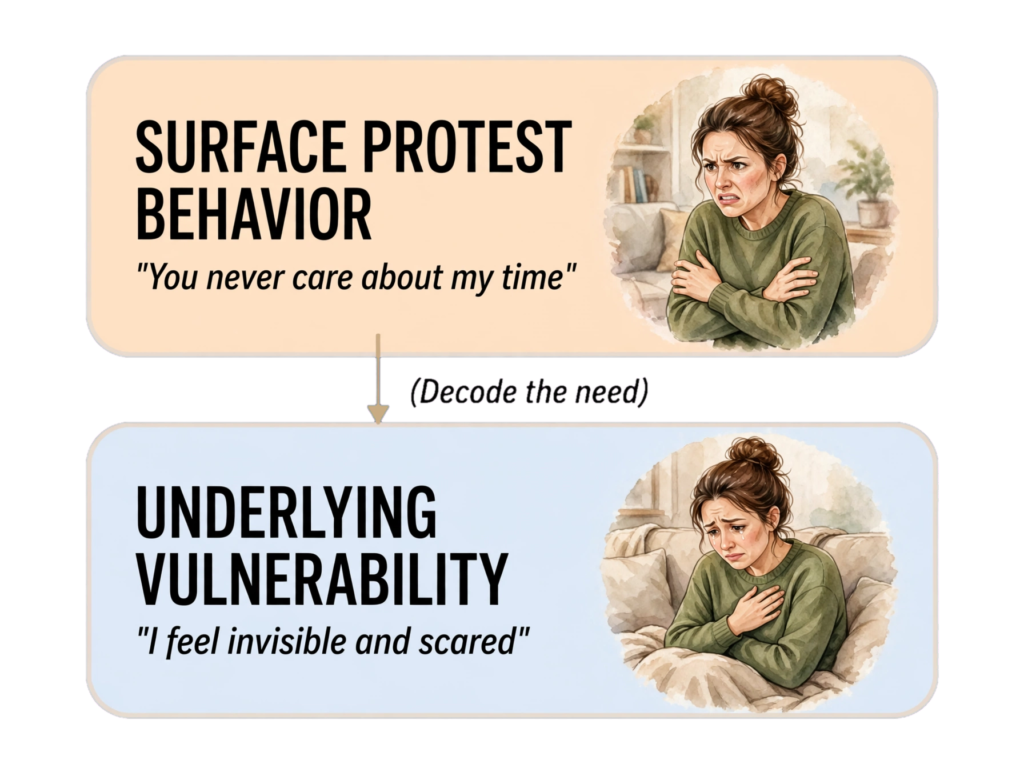
If you strip away the hostility, the passive aggression, and the desperate scorekeeping, every protest behavior is an indirect translation of three vulnerable questions:
- “Do I still matter to you?”
- “Can I count on you to turn toward me when I need you?”
- “Am I emotionally safe with you right now?”
Because your early attachment blueprint likely taught you that direct emotional vulnerability leads to shame, dismissal, or neglect, your subconscious learned to camouflage your needs. You learned that asking for reassurance directly was dangerous, so you adopted covert operations instead.
If you find yourself frequently caught in this exhausting loop, you might also struggle with feeling like you are fundamentally “too needy.” Recognizing these underlying patterns is the first step in realizing that your anxious attachment does not mean you are “too much”—it simply means your nervous system is operating on an outdated defense system.
Pushing Back on What’s Weak vs. Sharpening What’s Real
Let’s dismantle the common myths and half-truths surrounding protest behaviors in popular dating discourse:
Myth 1: “It’s just my attachment style, so my partner needs to adjust.”
The Counter-Argument: Having an anxious or fearful-avoidant attachment style explains your internal distress; it does not excuse behavior that destabilizes your relationship. Expecting your partner to absorb passive-aggressive comments, silent treatments, or manufactured jealousy is relational self-sabotage. Your pain is valid, but the way you express it remains entirely your responsibility.
Myth 2: “Protest behaviors show how deeply I care.”
The Counter-Argument: Protest behaviors do not signal depth of love; they signal the severity of autonomic dysregulation. When you confuse high-stakes drama and anxiety for passionate love, you end up trapped in destructive cycles. In fact, many individuals find themselves repeatedly sabotaging good relationships because real, calm security feels unfamiliar to an activated nervous system.
Myth 3: “If I find the right secure partner, I’ll never feel this panic again.”
The Counter-Argument: A secure partner will provide consistency, but they cannot rewire your neural pathways for you. Disconnection is inevitable in healthy human relationships. If you expect a partner to never trigger your panic, you will inevitably interpret normal human independence as abandonment. If you happen to be dating an avoidant partner, these unexamined dynamics will escalate into a toxic pursue-withdraw trap.
The 4-Step Protocol: From Reactive Protest to Secure Communication
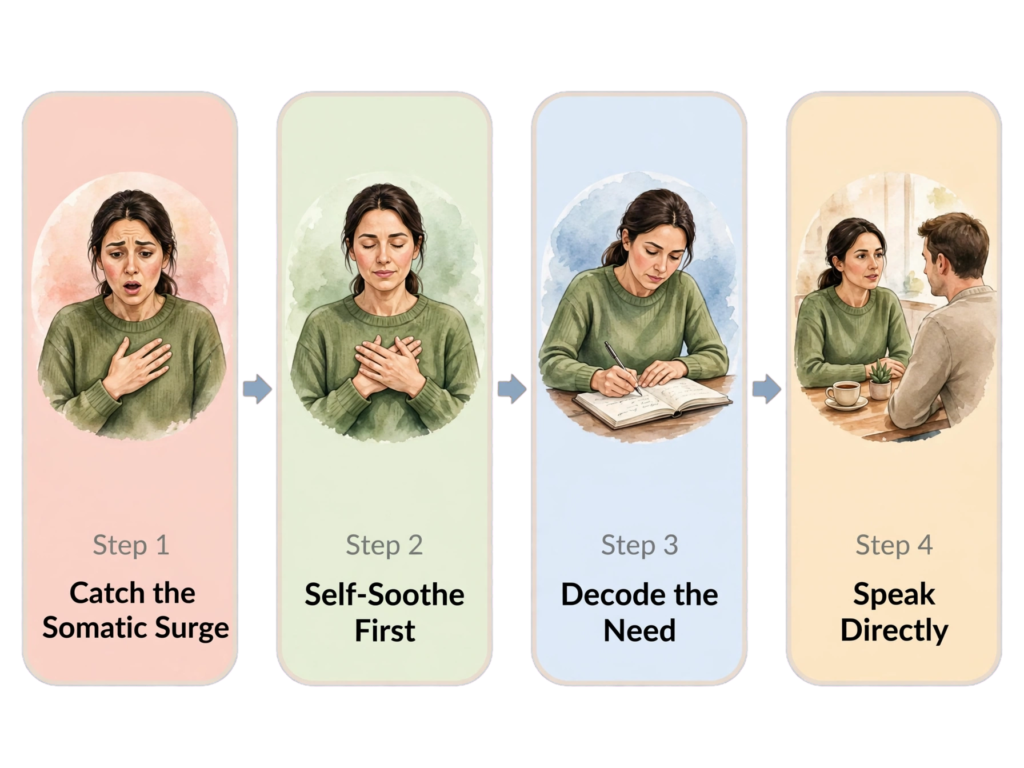
Transitioning from an insecure attachment strategy to earned security requires intervening between the physical trigger and your behavioral reaction.
Use this step-by-step framework the next time your attachment alarm sounds:
Step 1: Catch the Somatic Surge (The 90-Second Rule)
Neuroanatomist Dr. Jill Bolte Taylor famously noted that the chemical surge of an emotional trigger takes approximately 90 seconds to flush through the bloodstream.
Notice the physical signature: heat in the throat, clenched fists, shallow breath, or an urgent compulsion to grab your phone.
The Iron Rule: Never communicate while experiencing autonomic urgency. Urgency is the signature of the amygdala, not your authentic voice. Place the phone in another room.
Step 2: Regulate Your Body Before Processing Thoughts
You cannot think your way out of a physiological threat response with the very mind that feels threatened.
Lengthen your exhale: inhale for 4 seconds, exhale for 7 seconds. This activates the parasympathetic branch of the autonomic nervous system.
Engage sensory grounding: place your bare feet flat on the floor, or press your palms firmly against a cool surface.
Offer yourself internal reassurance: “My connection is not vanishing right now. My partner is allowed space, and I am safe in my own body.” This is the foundation of learning how to parent your inner child through acute distress.
Step 3: Decode the Real Need
Ask yourself: “What is the actual fear underneath this anger?”
Are you angry that they didn’t text back for three hours, or are you terrified that they are losing interest in you?
Name the underlying emotion without judgment: fear, shame, inadequacy, or grief.
Step 4: Express the Need Directly and Cleanly
Secure communication replaces testing and traps with direct, vulnerable bids for connection:
Instead of (Silent Treatment): Ignoring them for two days because they didn’t invite you to a casual gathering.
Secure Alternative: “When you made plans without checking in, I noticed myself feeling disconnected and left out. I’d love to plan some quality time together this weekend.”
Instead of (Passive-Aggressive Text): “Must be nice to have free time for everyone except me.”
Secure Alternative: “Hey, I’ve had a demanding day and am feeling a bit anxious. Could you send me a quick text when you get a second so we can connect?”
What Is Your Dominant Protest Behavior?
Answer these 4 clinical scenarios to uncover how your nervous system responds to relational distance.
Frequently Asked Questions About Protest Behaviors
Are protest behaviors manipulative?
Functionally, yes; intentionally, usually no. While protest behaviors attempt to manipulate a partner’s emotional state or physical proximity, they are rarely driven by malicious, Machiavellian motives. Rather, they represent unrefined survival bids executed by a dysregulated nervous system that lacks the skill or safety to ask for intimacy directly.
Do avoidant partners also have protest behaviors?
Yes. While protest behaviors are most commonly associated with anxious attachment, dismissive-avoidant and fearful-avoidant individuals use deactivating protest behaviors. These take the form of abrupt emotional withdrawal, dismissive eye-rolling, hostility, ghosting, or sudden hyper-fixation on a partner’s minor flaws to forcefully create space when intimacy feels overwhelming.
How do I respond if my partner is exhibiting protest behaviors?
Do not take the surface-level hostility at face value. Rather than reacting defensively to the biting remark or withdrawing in response to their silent treatment, address the underlying attachment bid: “I hear that you’re upset about this, but I care about you and want to understand what’s really going on. Can we take a breath and talk about what you need right now?” Hold boundaries around respectful treatment while validating the emotional bond.
Can you eliminate protest behaviors entirely?
You will likely always experience momentary triggers, but you can dismantle the behavioral reflex. Moving toward earned security does not mean you never experience relationship anxiety; it means the interval between feeling triggered and choosing clear, grounded communication becomes shorter and more intentional.
The Bottom Line: Moving Toward Earned Security
Protest behaviors are an attempt to protect you from the pain of disconnection, but they operate through mechanisms that practically guarantee it.
When you learn to catch the physical alarm, steady your own nervous system, and ask for what you need with clear, unarmored vulnerability, you stop surviving your relationships from a place of panic. You begin building an emotional bond where your authentic self can finally feel seen, valued, and safe.
Have a Story of Your Own?
Whether something in this post hit close to home, you have a question, or you just want to say hello — I read every message personally.