

This is educational content, not a substitute for therapy.
How to Parent Your Inner Child: The Science-Backed Blueprint for Soothing Relational Anxiety
You check your phone for the fourth time in twelve minutes.
Your partner’s text was uncharacteristically brief—just three words, no emoji, and sent three hours later than usual. On paper, you know they are buried in meetings. But in your body, an alarm has been pulled. Your heart rate climbs, a cold knot tightens behind your navel, and your thoughts begin to spiral: They’re pulling away. What did I do wrong? If I don’t fix this right now, I’m going to lose them.
Before you know it, you are drafting a reactive, passive-aggressive message—or pulling back into icy, defensive silence.
Pop-psychology tells you that this is simply your “inner child throwing a tantrum” and that you should validate every impulse. But if you’re honest, letting your inner child drive your relationship choices hasn’t made you feel secure; it has kept you trapped in cycles of chronic hypervigilance, exhausted partners, and post-reaction shame.
To build genuine, lasting peace in your intimate life, you must understand what is actually happening beneath the hood of your brain, stop the cycle of emotional regression, and step into the role of the authoritative, compassionate adult your nervous system never had.
The Neurobiology of an Attachment Trigger: Why Logic Vanishes
When an attachment trigger fires, you are not dealing with a rational adult dilemma; you are experiencing a subcortical neurobiological event.
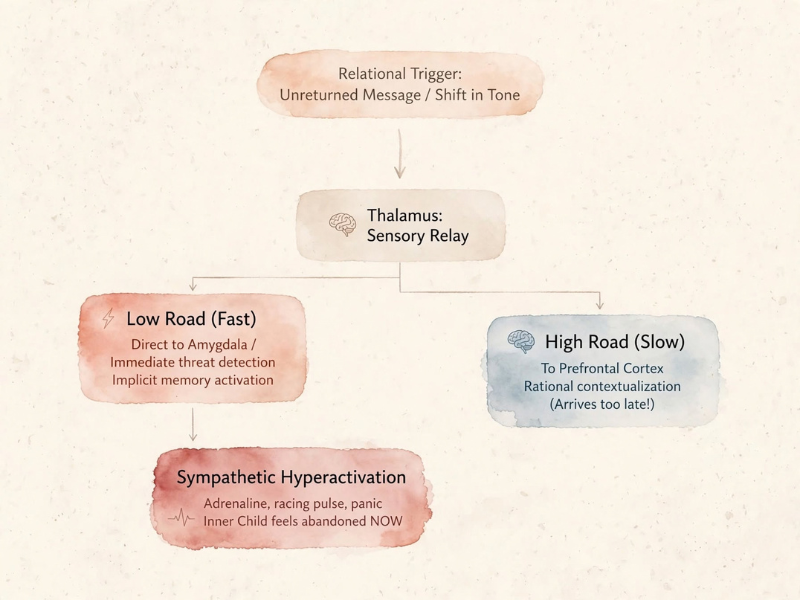
The Subcortical Hijack
Joseph LeDoux’s classic neuroscientific research highlights that sensory information travels along two distinct pathways: the “high road” through the neocortex, where logic and context reside, and the “low road” directly from the thalamus to the amygdala. The low road is extraordinarily fast—firing tens of milliseconds before your rational conscious mind can evaluate the situation.
Attachment wounds are encoded primarily within implicit memory—a system that catalogs bodily sensations, emotional states, and threat expectations without attaching an explicit calendar date. When your partner shifts their tone, your amygdala does not register a busy adult dealing with a workday; it registers the visceral threat of childhood isolation.
As psychiatrist Bessel van der Kolk famously notes in his trauma literature, the body keeps score. Under acute relational threat, your prefrontal cortex temporarily goes offline. Trying to use positive affirmations during this state is like whispering Shakespeare to someone fleeing a burning building: the physiology simply cannot receive the message.
To understand how these subcortical templates form, explore our deep dive on core wounds in relationships and how early attachment blueprints wire adult behavior.

Pushing Back on Pop-Psychology: Self-Leadership vs. Emotional Regression
The modern wellness internet has transformed inner child work into an excuse for chronic dysregulation. Let’s draw a firm, clinical line between healthy inner child work and unproductive emotional regression.
Attunement Is Not Capitulation
Reparenting does not mean giving your younger, frightened parts the keys to your life. When a toddler is terrified of thunder, a loving parent does not join the toddler under the bed, scream at the clouds, or let the toddler run into the street. The parent kneels down, offers physical warmth, validates the fear, and calmly maintains the safety of the house.
If you find yourself repeatedly sending barrage texts, manufacturing relational crises, or demanding instant reassurance to survive an emotional wave, you are not “honoring your inner child.” You are allowing an unparented, dysregulated child to manage an adult partnership. While social media often reduces this work to aesthetic affirmations, clinical frameworks in Psychology Today highlight that reparenting is a deliberate practice of self-compassion that pairs emotional warmth with firm, adult boundary-setting.
Many people remain self-aware but still stuck precisely because they can diagnose their childhood wound, but they have never built the executive adult capacity to intervene and guide it.
The Myth of the Partner-as-Parent
It is deeply comforting to imagine that the “right” person will anticipate our abandonment fears and love our wounds away. A secure, emotionally available partner provides an incredible space for relational healing, but they cannot act as an external nervous system for your unprocessed childhood panic.
Demanding that a partner constantly soothe your inner child creates an asymmetrical, parent-child dynamic that ultimately erodes romantic desire and emotional safety. Real security is an internal infrastructure you build so you can meet an adult partner as an equal.
The Four-Phase Clinical Protocol to Parent Your Inner Child
Reparenting is not an abstract concept; it is a tactical, repeatable protocol executed when internal distress peaks. When you feel relational anxiety rising, move through these four distinct phases in sequence.
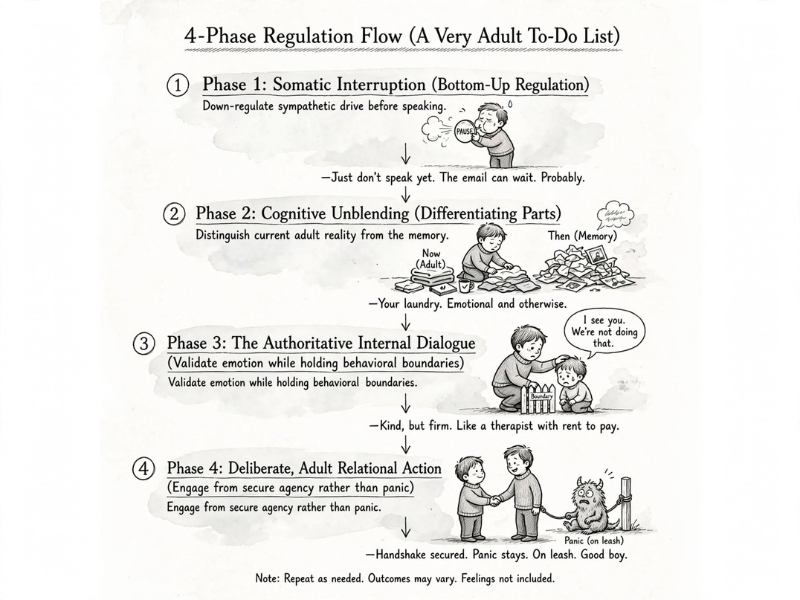
Phase 1: Somatic Interruption (Bottom-Up Regulation)
Before attempting to reframe your thoughts, you must signal baseline safety to the brainstem. In therapeutic frameworks such as Stephen Porges’ Polyvagal model (which, while scientifically nuanced in evolutionary theory, offers practical value for autonomic regulation), down-regulating sympathetic arousal requires physical cues:
The Double Physiological Sigh: Inhale deeply through the nose, top it off with a second sharp inhale, and let out a long, slow sigh through the mouth. This mechanically deflates carbon dioxide buildup and triggers parasympathetic vagal slowing of the heart rate.
Proprioceptive Anchoring: Press your feet firmly into the floor. Place one hand firmly over your sternum and the other over your lower abdomen. This tactile contact stimulates cutaneous receptors and releases endogenous oxytocin, providing an organic somatic brake on the fight-or-flight response.
The Phone Quarantine: Put down your device. Institute an unbreakable rule: No relational communication occurs while heart rate exceeds 90 beats per minute.
Phase 2: Cognitive Unblending (Differentiating Parts)
Drawn from Internal Family Systems (IFS) founded by Dr. Richard Schwartz, unblending is the practice of stepping back from an overwhelming emotion and viewing it as a part of you, rather than the entirety of your consciousness.
Instead of declaring:
“I am terrified and being abandoned.”
Shift the internal syntax to:
“I notice a young part of me is currently feeling extreme panic around abandonment.”
This semantic shift restores the Self—the grounded, adult executive center characterized by calm and curiosity. When you notice this panic driving your dating choices, it is often tied to how your early history conditioned your attractions; learn more about how your childhood affects your picker in dating to spot these unconscious repetitions early.
Phase 3: The Authoritative Internal Dialogue
Now that the executive adult is online, you speak directly to the young, activated state. This dialogue directly reflects what The Gottman Institute defines as emotion coaching: treating emotional distress as an opportunity for connection, validating the feeling without judgment, and providing clear behavioral limits. An attuned internal parent provides three essential elements: Validation, Orientation to Reality, and Firm Behavioral Boundaries.
Use this internal script:
Validation: “I hear you, and I see how tight your chest is. It makes complete sense that you’re scared right now. In the past, people being silent meant you were forgotten or in trouble. Your fear is completely understandable.”
Orientation to Reality: “Look at where we are. We are in our adult body, sitting in our living room. We are financially independent, emotionally capable, and physically safe. Even if this person turns out to be wrong for us, our survival is not in danger. I am here, and I will not leave you.”
Behavioral Boundary: “Because I love and protect us, I am not going to let you send three frantic text messages right now. I am in charge of this situation, and we are going to wait until our system is completely clear.”
When you master this dialogue, you break the cycle of self-betrayal; read our guide on signs of self-abandonment in relationships to identify where you might still be compromising your adult boundaries.
Phase 4: Deliberate, Adult Relational Action
Only after somatic and cognitive regulation is restored do you take action. You are no longer engaging in protest behaviors (demanding reassurance, guilt-tripping, or playing games).
If an honest conversation is required, you speak as an integrated adult:
“Hey, when our communication drops off for several hours without a heads-up, it feels disconnected to me. I prefer more consistency during the week. Let’s talk about what pacing works for both of us.”
If the other person cannot or will not meet you in a secure harbor, an integrated adult evaluates compatibility cleanly, rather than clinging harder out of panic. If you struggle with this fear of abandonment, explore our strategic roadmap to heal anxious attachment and feel secure.
The Reality of “Earned Security”: Transforming Your Narrative
A common fear among people doing deep attachment work is that they are permanently broken by their childhood environments.
However, one of the most liberating discoveries in modern psychology—documented extensively across Adult Attachment Interview studies by researchers Mary Main and Erik Hesse—is the phenomenon of Earned Security. Individuals who endured chronic childhood misattunement, emotional neglect, or chaotic caregiving can—and frequently do—arrive at the exact same psychological and relational stability as those born into secure households.
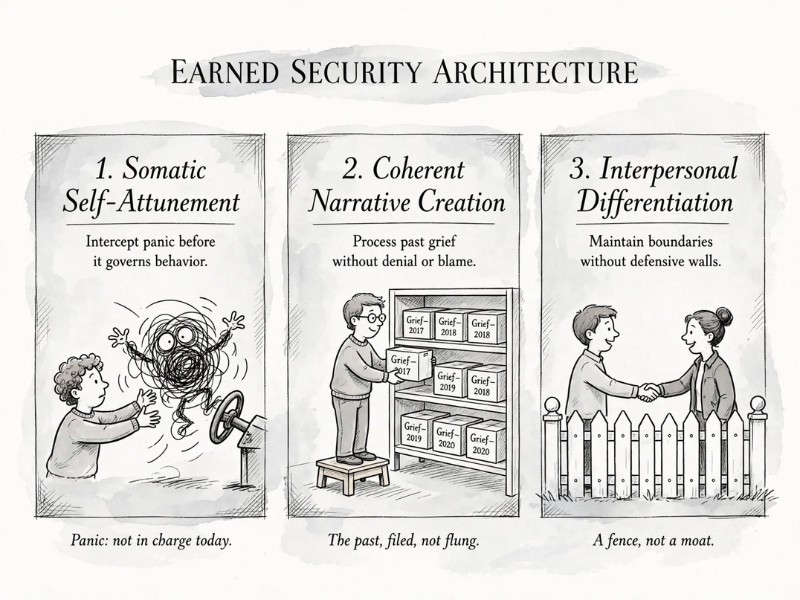
Earned security does not require rewriting history to pretend your childhood was sunny. Rather, it requires achieving narrative coherence: the ability to look back at what hurt, acknowledge the developmental gaps without rage or minimization, and take full responsibility for how you care for yourself today.
You are no longer an infant waiting for an adult to realize you are crying in the dark. You are the adult who has arrived. If you constantly battle the underlying fear that your genuine needs make you difficult to love, be sure to read our breakdown on anxious attachment and the fear of being “too much”.
Micro-Audit: What Is Your Default Inner Child Attachment State?
Answer 3 quick questions to uncover your nervous system's habitual trigger response.
Frequently Asked Questions About Reparenting Your Inner Child
What does it actually mean to “parent” your inner child?
To parent your inner child means utilizing your adult executive functioning (the prefrontal cortex) to actively soothe, regulate, and set boundaries for your nervous system’s subconscious, historical survival reactions. Rather than acting out emotional impulses (like protest texting or withdrawing) or shaming yourself for feeling anxious, you acknowledge the younger emotional state with compassion while firmly managing your outward adult actions.
Why can’t I just use positive affirmations to calm my relationship anxiety?
Attachment anxiety originates in subcortical brain structures (such as the amygdala) and the autonomic nervous system via implicit memory. Because these regions respond to physiological sensations rather than verbal syntax during an acute trigger, cognitive affirmations cannot easily penetrate a state of sympathetic hyperarousal. You must regulate the body first using somatic, bottom-up techniques before cognitive reappraisal becomes effective.
What is the difference between reparenting and emotional regression?
Emotional regression occurs when an adult unconsciously allows an activated, fearful childhood state to dictate their external behavior—resulting in tantrums, demanding reassurance, guilt-tripping, or emotional shutdown. Reparenting is the exact opposite: it is an act of adult self-leadership where you step in as the authoritative, protective caregiver who witnesses the inner distress while maintaining healthy adult conduct.
Can a secure partner fix my childhood attachment wounds for me?
While an emotionally secure and consistent partner provides an invaluable environment for healing, they cannot replace your internal regulatory architecture. Expecting a partner to preemptively soothe every trigger fosters codependency and parentifies the relationship. True healing requires internalizing the secure attachment figure so that you can self-regulate and meet your partner as an equal.
What is “earned security” in attachment theory?
Earned security is an empirical finding developed by attachment researchers Mary Main and Erik Hesse. It demonstrates that adults who grew up with insecure, neglectful, or inconsistent caregiving can achieve the exact same emotional resilience and secure relationship patterns as those from secure backgrounds. It is cultivated through narrative coherence—the capacity to make objective, compassionate sense of past adversity and build reliable self-regulation in the present.
Have a Story of Your Own?
Whether something in this post hit close to home, you have a question, or you just want to say hello — I read every message personally.